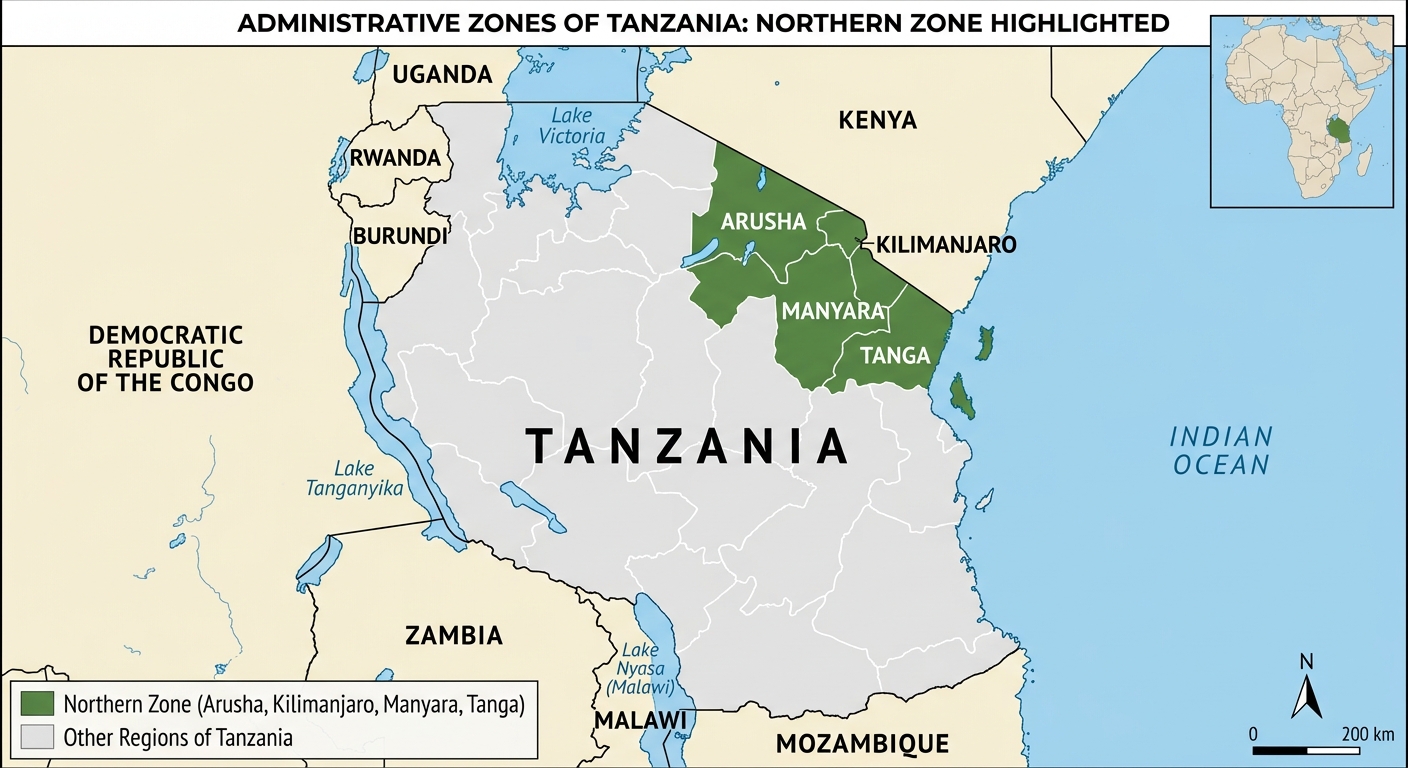
Northern Zone Regions
Northern Zone of Tanzania is comprised of Arusha, Kilimanjaro, Manyara , and Tanga regions: it has an area of 125,455 square kilometers (Arusha 34,526 Sq. km: Kilimanjaro 13,209 Sq.km: Manyara 50,819 Sq. km and Tanga 27,342 Sq.km) that is equivalent to 13.3 percent of the national total land area. According to 2012 population and housing census, the population is 6,804,733 people which is equivalent to 15.15 percent of Tanzania population. The population size of each region stands as follows: Arusha 1,694,310; Kilimanjaro 1, 640,087; Manyara 1,425,131 and Tanga 2,045,205. The northern zone has moderate temperature. It has two rainy seasons, whereby short rainy season start from October to December and long rainy season start from March to May. Remember, Tanga region is sometimes placed in Eastern zone rather than Northern zone due to its geographical position.
- Arusha (The centre for Tourism & Cultural Heritage)
- Kilimanjaro (“Home of the Snowcapped Mountain)
- Manyara (“Home of Tanzanite)
- Tanga (“The land of Sisal)
Arusha Region Profile (Fast Facts) & Map/ Main places to visit
Arusha,Karatu,West Arumeru,East Arumeru,Longido,Monduli,Ngorongoro
Arusha Region in Brief:
Arusha Region is situated in northern Tanzania, just below Mount Meru and at an elevation of 1,500 m above sea level, the fast growing town of Arusha has long been the ideal gateway to East Africa’s most famous wildlife areas: it is now also a popular centre for international meetings, conventions, and conferences. Indeed, it has also become the main trading centre for Tanzanite; a unique gemstone mined in northern Tanzania and found nowhere else in the world. Lying halfway between Cairo and Cape Town, the town has a history that starts in the last decade of the 19th century when Captain Johannes built a fort at the foot of Mount Meru to facilitate the German colonization of what later became known as Tanganyika. From the little fort, which still stands and has been converted into a museum of natural history, the town of Arusha grew: first as a trading post for the local people, and now into a famous center for various international activities. The visit of the former U.S President Bill Clinton in 2000 left the town with the praise name the Genera of Africa. As the hub of the country’s tourism industry, Arusha is the starting point for many wildlife and climbing point for many wildlife and climbing safaris in the northern circuit of Tanzania wildlife sanctuaries. The circuit encompasses the famous national parks of Serengeti, Tarangire, and Lake Manyara as well as the great landmarks of Ngorongoro Crater, Oldupai Gorge, and Mount Kilimanjaro, Africa’s highest Mountain. The town is also home to the headquarters of Tanzania National Parks as well as a branch office for African wildlife Foundation and other conservation institutions. As a center for various international activities, today Arusha is the headquarters of the East Africa Community (E.A.C). E.A.C is an organic of economic cooperation among the seven (7) East African countries of Kenya, Uganda, Rwanda, Burundi, Tanzania, Democratic Republic of Congo (DRC), and South Sudan. Another international body, one of many centred in Arusha, is Esami (Eastern and Southern African Management Institute). With such a background as a place for safari makers, delegates, and prospectors, Arusha has hotels, restaurants, and shops of all standards. The Town has a wide assortment of safari companies and several tourism information offices, including the Tanzania Tourist Board near the clock Tower. The town is connected to the rest of the world by Kilimanjaro International Airport, 42 km away, and the great North Road that enters Tanzania from Nairobi, Kenya.
Getting There / How to get in Arusha
- By Air; Kilimanjaro International Airport and Arusha Airport serve the town of Arusha. The former is about a half – hour’s drive away on the Moshi road, and the latter is just at the outskirts of the town on the Dodoma Road. International airlines that use Kilimanjaro International Airport include KLM, Turkish Air, Air Uganda, Quatar Airways, Ethiopian Airlines, Precision Air, Condor Air, Kenya Airways and Air Tanzania. A number of domestic airlines connect Arusha with Zanzibar and other main towns of Tanzania. Some of these are Regional Air, Northern Air, Coastal Aviation, Zan Air, and Air Excell. Most of these offer charter services and so land in the airstrips of the northern tourism circuit.
- By Road: Arusha is accessible by road from virtually any corner of the country. First the road from Dar es Salaam to Nairobi, via Moshi goes through Arusha and is well served by a number of shuttle buses, as well as the intercity public buses. These intercity buses also connect Arusha with the coastal town of Tanga. Secondly, Arusha is connected to the gates of the national parks of the northern circuit by good paved roads.
Kilimanjaro Region Profile (Fast Facts) & Map/ Main places to visit
Hai,Siha,Moshi Urban,Mwanga,East Same,West Same,Moshi Rural,Vunjo,Rombo
Kilimanjaro Region in Brief:
Kilimanjaro Region is famous for its snowcapped Mount Kilimanjaro, with the highest peak at 5,895 meters above sea level, and adjacent to it within the region is the stretch of North and South Pare Mountains 2,000 – 2,500 meters above sea level. The region is divided into six (6) administrative districts, namely; Moshi(Rural & Urban), Rombo, Mwanga, Same, Hai, and Siha. The Region is also bordering with the Republic of Kenya which is an opportunity to be exploited in the promotion of trade among the seven (7) East African Community member states of TANZANIA, KENYA, UGANDA, RWANDA, BURUNDI, SOUTH SUDAN, and DRC ( Democratic Republic of Congo)
Manyara Region Profile (Fast Facts) & Map/ Main places to visit
Babati Urban,Babati Rural,Hanang,Kiteto,Mbulu Urban,Mbulu Rural,Simanjiro
Tanga Region Profile (Fast Facts) & Map/ Main places
Tanga Urban,Lushoto,Bumbuli,Mlalo,Pangani,Kilindi,Mkinga,Handeni Urban,Handeni Rural,Muheza,Korogwe Urban,Korogwe Rural
Tanga Region in Brief:
Tanga Region has a rich history which unfolds real and interesting stories of explorers like Vasco Da Gama, Arabs and Asians, trading activities, slave trade, the advent of German colonists and finally the British rule. The capital of the region is situated on the shores of the Great Indian Ocean from where all activities radiate towards other parts of the region. The city is rich in history, natural attractions, period architecture and interesting aquatic species. South of Tanga lies a prominent trading centre of the 19th century, PANGANI. Pangani has some of the most spectacular unpolluted beaches in the country and is an excellent beach holiday destination. To the further south is the little known SAADANI NATIONAL PARK with beach and wild animals that enjoy the sea breeze. To the west of Tanga and on the East Usambara Mountains lies a beautiful hill station – AMANI NATURE FOREST REERVE. This is the nest of flora and fauna.
